How to plan a small balcony you will actually use
Morning coffee, reading or dinner for two: choosing one main use helps preserve space on a small balcony.
Choose one moment to add to your day
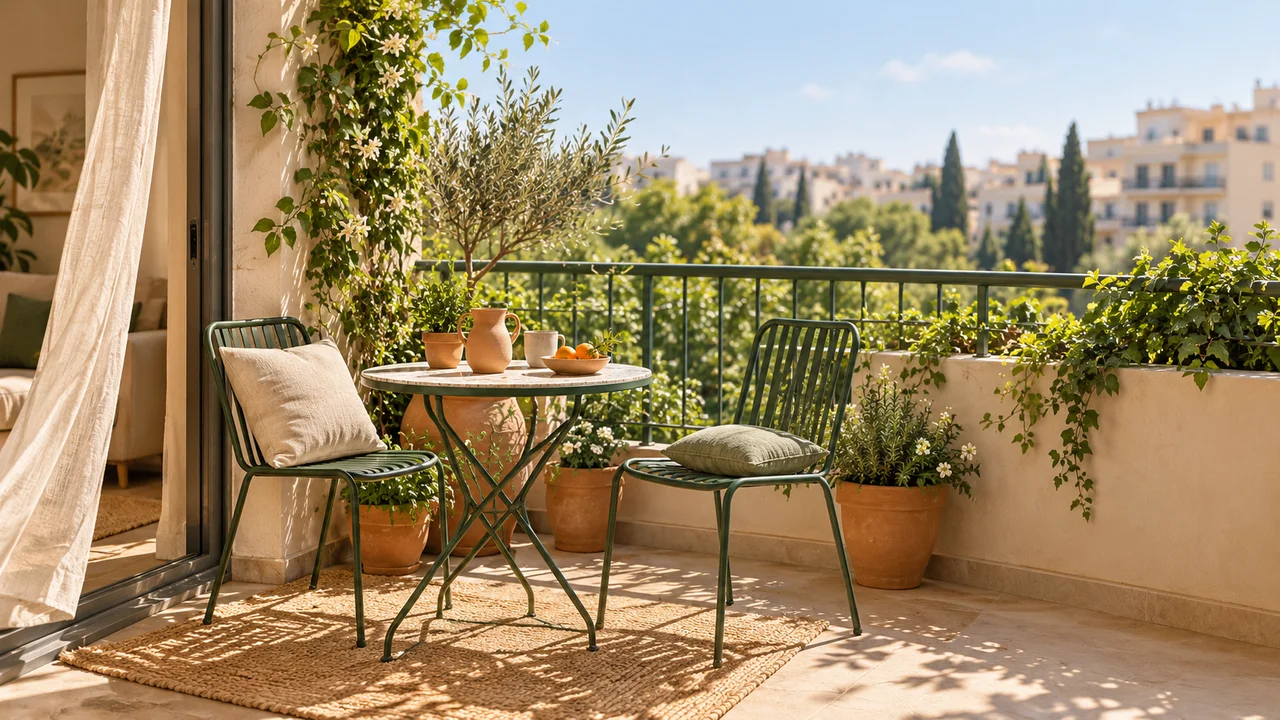
Planning a small balcony starts with what you actually want to do there. A quick coffee needs a different arrangement from a workspace or dinner for two. Instead of fitting in every possibility, choose a main use and one secondary use that is easy to add. If you mostly want to read alone, a comfortable chair and somewhere for a mug may serve you better than a large dining table. A small balcony benefits from a clear choice because every unnecessary item takes space from the activity that brought you outside.
Measure movement too
Record the dimensions, but go beyond width and length. Check how the door opens, what is beside the exit and how much room you need to sit and stand. Mark the outlines of possible furniture on the floor with paper or temporary markings that will not damage the surface. Walk between them as though the chairs were already there. A table that fits on paper may obstruct every movement of a chair. This small exercise can prevent an unsuitable purchase.
Observe before buying
Go onto the balcony at the times you intend to use it. Notice the light direction, sense of exposure and surrounding noise. A corner that is pleasant in the evening is not necessarily where you want to sit in the morning. This observation helps position furniture and identify which accessories are genuinely missing. You do not need to buy a solution for every possible situation immediately. Start with the most likely use and spend a few days seeing what makes it difficult before buying anything else.
Give furniture more than one role
In a small space, consider whether furniture is easy to move and useful in more than one arrangement. A side table may be enough for coffee and move aside when space is needed. A folding chair can serve a guest without taking permanent space when unused. Check dimensions both open and closed, and where a folding item will be stored. Furniture does not become useful simply because its label says it suits a balcony. It needs to fit the way you live and the space you have.
Add plants without losing the floor
One plant suited to the conditions can add interest without making the balcony an obstacle course. Before choosing plants, describe the light and conditions to the nursery, along with the time you want to spend on care. Group items in a defined area rather than scatter them along the passage. Keep easy access for cleaning and to existing drainage. Hanging, securing or altering the structure requires separate checking with an appropriate professional, rather than a decision based on an inspiration photograph.
Leave room for the arrangement to change
Use the balcony with just a few items before finishing the decoration. You may discover the chair is better facing elsewhere, the cushion always stays indoors or the table is rarely used. Small, accessible storage for useful accessories is better than a collection that complicates cleaning. Choose things that are easy to put away after sitting and remove items unrelated to the space's use. The balcony becomes part of the home when you can step outside without first moving half a storeroom.