
Why Lies About Israel Get Clicks, and What to Check Before You Share
Outrage can give a false claim an audience. Before sharing, check the source, date and evidence, even when the post agrees with your views.
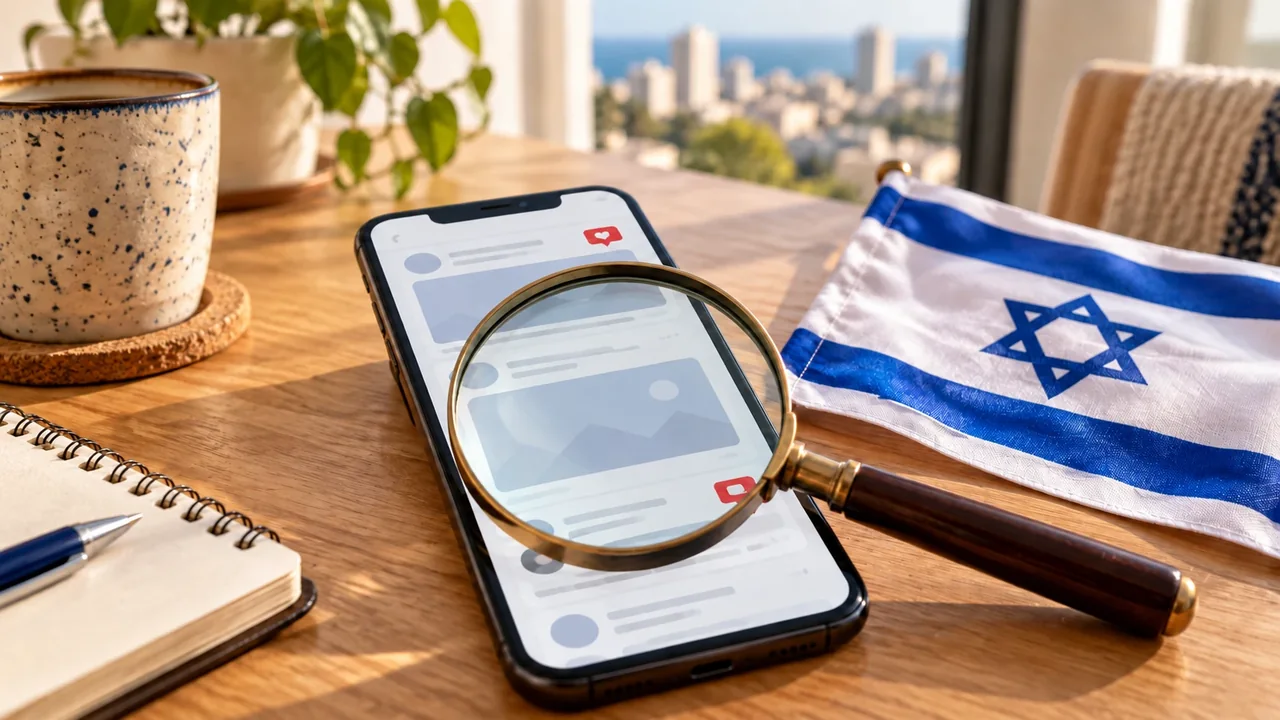
Lies about Israel get clicks. Those clicks give the people spreading them an audience, while readers are left sorting through accusations, arguments and corrections.
The problem reaches into an ordinary moment: opening your phone, seeing an outrageous post and deciding whether to share it. A claim can demand a reaction before you have even checked where it came from. That reaction is part of what makes it valuable to its publisher.
Asked to compare factual reporting about Israel on X with sensational, unverified and unproven claims, Grok estimated that the latter could attract five to 20 times as many views, sometimes 50 times or more when a post goes viral. These are AI-generated estimates, not independently verified engagement statistics.
The comparison expresses the incentive clearly: a lie can get 10 times the attention of the truth. For readers, the useful question is how to avoid helping it along.
An accusation gives people something to react to
A factual report may need to explain what happened, who provided the information and which details remain unclear. An outrageous accusation can fit into a single sentence.
That makes it easy to absorb and easy to pass on. Someone agrees and shares it. Someone else becomes angry and replies. A third person sends it to a group chat to ask whether it is true.
Those reactions have different intentions, but each can put the accusation in front of another person. Even someone trying to challenge a lie can introduce it to readers who had never encountered it.
Meanwhile, the original publisher has already gained attention. Establishing what actually happened becomes somebody else’s work.
A view count cannot tell you whether something happened
A post with hundreds of thousands of views can look significant. It tells you that the post attracted attention. It does not tell you whether the photograph is recent, the translation is accurate or the accusation is supported.
The distinction matters when several accounts repeat the same claim. Before treating that repetition as confirmation, check whether the accounts have separate evidence or are all pointing back to one original post.
Ten accounts repeating an unsupported accusation do not provide ten independent sources.
The same applies to screenshots. A screenshot may preserve someone’s words, but without the original post it can leave out the date, surrounding discussion or a subsequent correction. Sometimes the most useful thing to look for is simply the source that everyone else has skipped.
Before sharing, make three quick checks
You do not need to investigate every post in your feed. When you are considering passing one on, however, a few checks can help.
Find the original source. Follow the link, open the full statement or look for the original upload. If the post makes a serious accusation but offers no traceable evidence, there is a reason to pause.
Check the date and context. Does the material actually concern the event described? Does the full video support the caption? An authentic image can still be presented with a false explanation.
Separate the evidence from the wording. Identify what the material establishes, then compare it with what the account claims. A confident caption cannot fill a gap in the evidence.
These checks apply just as much to a post that supports your views. Agreement is a reason something feels convincing, not proof that it is correct.
Correct a false claim without making it the main attraction
Some lies deserve a direct response. When answering one, lead with the verified information and give readers a source they can examine.
Explain the specific error. If a video is from a different date, show that. If a quotation has been cut short, provide the relevant context. A clear correction gives readers something they can use beyond another angry exchange.
Think about whether you need to reproduce the entire accusation. You may be able to explain the falsehood and present the evidence without sharing its most inflammatory wording or imagery.
The underlying incentive remains: more outrage can bring more clicks, giving those spreading lies about Israel a reason to continue.
Readers have a choice at the moment that cycle reaches their screen. Before giving an accusation another audience, check whether it has earned your trust.